
Everything related to Balochi needlework and its cultural identity
Balochi needlework is one of the most beautiful Iranian cultural arts, which is widely used among the people of Baluchistan, but unfortunately, there is no detailed history available regarding the history of this art, but some studies show that Balochi needlework was first developed by the “Ilkhani” tribe.
The art of needlework is very popular among Baloch women, and the people of Baluchistan consider this art as an expression of their culture and traditions. This method of embroidery is the most used method to decorate clothes, especially simple and local clothing.
For example, on women’s clothing (mostly traditional Balochi dresses) , needlework is used in four parts. These parts include the top of the sleeves, the chest area, and the lower part of the chest, which is sewn vertically to the bottom of the dress, as well as the pockets (and in the clothes that also include pants, the lower part of the pants are also embroidered.)
The beautiful art of Baloch needlework is one of the most authentic Iranian methods in the field of embroidery, and researchers have found similar works of this art in pre-Islamic petroglyphs and pottery. This shows how this form of art goes way back.
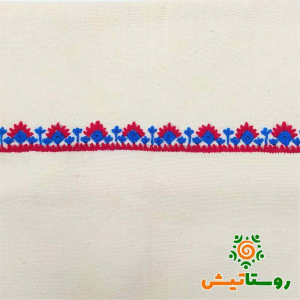
What kind of stitches are used in Balochi needlework?
As we mentioned, needlework is one of the most common original arts of embroidery in Iranian handicrafts, decorating fabric using regular geometric shapes derived from natural elements is the main feature of needlework that has made it popular. But in relation to Balochi needlework, it can be said that the type of stitching in each region of Sistan and Baluchistan province has differences from each other and in each region a special name has been chosen for the type of stitching.
In general, two types of sewing are very common among the people of Baluchistan.
The role and place of needlework among Baloch people
Always Wearing the traditional Balochi clothes is a certain norm among the Baloch people.
So needlework in traditional clothes can be considered a part of the culture of this province, the symbols sewn in traditional clothes can be considered ethnic belonging.
It is interesting to know that the art of needlework is also popular among the Baloch people of Pakistan, Afghanistan and Turkmenistan.

Tools used for needlework
Needlework is an art in which the artist can create with just a few simple tools. Of course, let’s not forget the sufficient skill and hard work and persistence that goes into it.
The working tools in this industry are:
1- needle
2- Thimble
3- Scissors
The needle or “Suchen” (in Balochi language is called Suchen or Sichen) is the main tool, the size of the needle can be changed depending on the type of sewing and the desired fabric.
Raw materials needed in needlework:
Regarding needlework, you probably can guess that thread and fabric are the main raw materials that are needed. The important thing about these raw materials is that in this art, colors are limited and you are only allowed to use six colors.
The use of these colors has a special order and there are rules that the artist must follow.
The colors used in fabric are:
Burgundy or maroon, red, orange, black, white, green and blue.
The colors of “Suchen Duzi” (needlework) threads:
1- Seven-color thread (this type of thread originally contains 6 colors)
2- two-color yarn (brown and red yarn)
3- Use of single color thread (white, black or brown)
The threads used in this art are usually silk threads, because these threads are of better quality and give a better effect to the sewing pattern.
Types of work in Balochi needlework
In Balochi needlework, sewing is usually done in two ways, this sewing can include a heavier type of work or small work. The former’s stitches are said to be a type of needlework that has a high level of delicacy, and basically, these types of stitches are very time-consuming and require a lot of effort, because the motifs in the elaborate designs are very small and delicate; In contrast to smaller designs and micro-stitches, which is a type of stitch that the embroiderer takes less time to do, because in these designs, large patterns are used. Clothes and items that have the heavier type of stitching usually have a much higher price.

Application of Balochi needlework
In general, we know that Balochi needlework is used to decorate all kinds of artistic products that are cloth in Balochistan, but without a doubt, the main use of Balochi needlework that has been popular since the past is to decorate Balochi women’s clothes, especially traditional clothes. This stitch is also used to decorate cloth tablecloths, curtains, rugs and needlework cushions and even some jewelry. It is interesting to know that nowadays needlework pieces are used in sewing some formal clothing like coats and even different bags.
The most important and impressive feature in Balochi needlework are the patterns. The generality of these designs are the same in all decorations, but Baloch women can make changes in them based on their taste and experience.
The types of patterns in needlework are:
Geometric patterns:
Geometric patterns are one of the most widely used motifs in needlework, geometric patterns can be very diverse due to their characteristics, the use of proportions in geometric shapes such as triangles, rhombuses, squares, and other shapes.
Animal motifs:
In embroidery, animal patterns are divided into realistic patterns and abstract patterns. Abstract animal motifs are usually derived from the characteristics of animals that exist in Baluchistan; For example, the camel tail design is one of the most widely used needlework patterns.
But the realistic animal motifs refers to the design of the specific look of animals, the use of these designs in needlework is very rare, unlike abstract animal motifs, and these motifs are usually used to create other arts such as rugs and carpets.
Plant patterns:
Plant motifs are basically the transformation of realistic flowers into a symbolic appearance, the existence of high diversity in flowers is the reason for using these symbols in needlework. Women use their creativity to create plant patterns.
Plant patterns are mostly abstract designs that are created by maintaining geometric features.
Human patterns:
These patterns are also very abstract and they don’t necessarily look like a human, but have similar characteristics and are a product of very creative minds.
As we said, needlework production has expanded and is not only limited to the traditional clothes of Baluchistan, nowadays artists in handicrafts use this art to create other works such as bedspreads, rugs, tablecloths, curtains, ties, bags and even shoes.
you can purchase all kinds of Balochi needlework handmade by th women of Baluchistan at https://roostatish.com/
You can also click on the links bellow to read about: