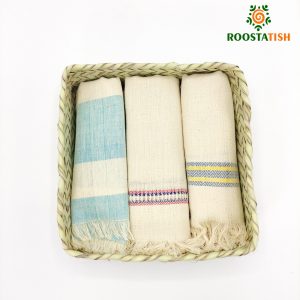
Woven with natural local cotton
Tobafi is made using local natural cotton with a brown color called Meleh. This cotton has an economic value almost three times that of white cotton, and its planting is carried out exclusively in Khosef city in South Khorasan province. In Khosef, about ten tons of cotton are harvested annually in seven hectares.
This city has been nationally registered as the city of millet and millet weaving due to its extensive activity and the high cultivated area of this type of cotton, and there are plans at the level of the city to provide the necessary infrastructure to increase its cultivation and also to protect this traditional process. It has been done.
Currently, the cultural heritage of Khosf city is looking for suitable places to grow Meleh cotton seeds, so that in addition to Majhan, Khor, Garjagan, and Khosf, other regions can also benefit from the production of this product. Because milled natural fiber cotton, such as white cotton, can be used in the weaving of all kinds of fabrics, all people who are skilled in weaving can use it as the raw material of their products, but this
Seed cotton has little availability and is considered a risky crop for farmers due to its sensitivity to weather and lack of insurance, that is why its cultivation has decreased over time.
Mele cotton has a long history in South Khorasan and is considered one of the heritage of South Khorasan. Mele natural fiber cotton is used to weave various products such as rugs, praying rugs and scarves. The inhabitants and natives of the Mele area consider cotton and everything woven from it to be auspicious. Mela cotton has a color similar to the soil in which it is planted, and it got its name from this soil, which is called Mel.
Due to the indigenous nature of the cotton planting and production process, it is not possible to sell Meleh cotton raw, and secondary products are produced exclusively in the South Khorasan region. Meleh cotton production stages include planting, growing and harvesting it like normal cotton, but it is not resistant to drought and cold, that is why annual crop insurance is necessary for farmers, otherwise a large part of their crop may be lost under the influence of climate change.
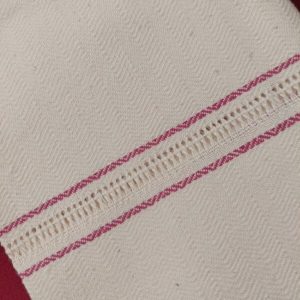
The stages of turning milled cotton into yarn
Millet cotton is turned into yarn in four steps, which are as follows:
First step: separating the cotton seed from the cotton husk with a hoe
Millet cotton fibers are shorter than white cotton, that’s why it cannot be tied with a bow.
The second step: smoothing the milled cotton with a cotton pad
Cotton grinding is done with a fork and on a wooden pillow.
The third step: turning milled cotton into yarn with a spinning wheel
The fourth step: turning the thread into a coil by the waknok.
Types of threads used in tobafi
Traditionally, in tobafi or tonabafi, cotton, silk, fluffy or corgi and cotton thread are used, but woolen thread, synthetic thread, acrylic thread, and cotton thread are also used in the process of weaving these beautiful and valuable handwovens. Silk fabrics in different colors, including purple, garlic and purple, and very finely woven, called Qanabiz and Vala, which are used in the traditional weaving of the region, are famous for making women’s clothes. Among the weaving areas of this type of cloth is Cherme district, one of the functions of Sarayan city.
Entrepreneurship and economic development by reviving the art of towel weaving
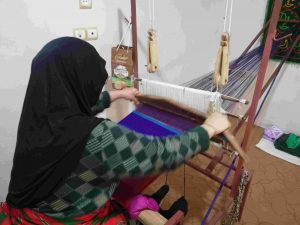
The weaving of traditional towels in South Khorasan is done with centuries-old originality and as in the past, with traditional two- or four-row machines and simple work tools, and is the art of village women. Earning income for the villagers whose economy and livelihood were endangered due to drought is the motivation to expand and grow the traditional weaving workshops. With the rise of this public determination and participation in national exhibitions, traditional woven fabric or tobafi came out of the village storehouse to be registered as a national art and craft.
Khorashad village is one of the functions of Birjand city, which, with the development of traditional textile weaving and the establishment of two cooperative companies with 520 members, high volume of production and participation in national and international exhibitions, was able to attract the attention of UNESCO’s evaluators for world registration. Currently, this village has 170 active workshops, several ecotourism residences, a bazaar selling handicrafts and rural furniture, which, in addition to creating a suitable and pleasant environment for tourists, helps the growth of the village’s economy and the recognition of its cultural heritage by attracting domestic and foreign tourists.
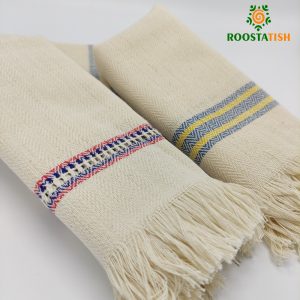
How to work in towel weaving
In order to weave the cloth by the ton weaving method, first the raw material of the weave, i.e. wool or fluff, is prepared and spun by hand. The spun threads are boiled and passed through flour to make it thicker. The cotton thread that is produced in this way is the primary material used in the weaving of this traditional fabric, which is woven as a weft on the side of the chela.
Traditional towel weaving is done in three stages. The method of work is that cotton threads are first prepared using a spinning wheel and a bobbin wheel, and then in an open space using a number of thin and equal-sized pieces of wood, skeeling is done, which is called “skeeling” in the local term.
All kinds of towel weaving products
Towels woven by the traditional weaving method, which is done entirely with weaving machines, for weaving all kinds of textiles with various uses, such as hand and face towels, bath towels, swimming pools, strainers, tablecloths or bread tables, nightshades, table napkins, handkerchiefs, headscarves, rugs. , clothes and other things are used.
With the help and support of the General Department of Cultural Heritage of South Khorasan, hand-woven towels of South Khorasan, which are very light and have excellent water absorption, are offered to pilgrims as Ihram clothes. This lightweight towel is perfect for traveling, especially in hot, dry climates.
All kinds of towel weaving products
Towels woven by the traditional weaving method, which is done entirely with weaving machines, for weaving all kinds of textiles with various uses, such as hand and face towels, bath towels, swimming pools, strainers, tablecloths or bread tables, nightshades, table napkins, handkerchiefs, headscarves, rugs. , clothes and other things are used.
With the help and support of the General Department of Cultural Heritage of South Khorasan, hand-woven towels of South Khorasan, which are very light and have excellent water absorption, are offered to pilgrims as Ihram clothes. This lightweight towel is perfect for traveling, especially in hot, dry climates.
The use of this traditional weaving method in the form of a new and efficient product and placing it in the luggage of pilgrims expands the market of this product and provides the possibility of pursuing extensive entrepreneurial economic plans in the region.
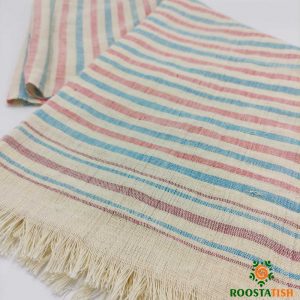
Towbafi products in international markets
One of the other pleasant events that became possible after continuous follow-up and efforts of the residents was the presentation of Birjand’s traditional handwoven fabric in international exhibitions and the attention of merchants to this product. For the first time at the Nowruz Handicraft Exhibition of Mashhad, Emirati merchants liked the softness and lightness and the unique traditional fabric of Tobafi and ordered fabric from the cooperative of this village.
The high quality of the product, the traditional texture, the unique work method, the use of vegetable dyes and completely natural textiles were the motivation of these businessmen to order. Ordering traditional cotton shawls, natural fiber towels, which were woven and dyed by hand in a completely traditional way, and sending them to Arab and even European countries, including Germany, Holland and France, has widened the Tobafi market.
Supporting as much as possible the cultural heritage organization of the province for the presence of artisans of South Khorasan in national and international exhibitions, providing loans, investing in education and marketing are the factors that should be taken into consideration for the growth of the traditional fabric and the art of weaving.
Finally, the successful supply of products such as hand-woven cotton towels that have lived in the country’s rich rural culture for years to be coordinated with the needs and demands of customers and bring the export of the culture and craftsmanship of Iranian artisans to the farthest corners of the world requires the determination of all and the cooperation of various organizations. It is to inspire other artists to revive the heritage of their ancestors and use it both to improve their livelihood and to introduce their culture to the world.